
2019年7月30日 星期二
DCGANs_Paper(翻譯)
DCGANs_Paper(翻譯)
說明
區塊如下分類,原文區塊為藍底,翻譯區塊為綠底
原文
翻譯
任何的翻譯不通暢部份都請留言指導
ABSTRACT
In recent years, supervised learning with convolutional networks (CNNs) has
seen huge adoption in computer vision applications. Comparatively, unsupervised
learning with CNNs has received less attention. In this work we hope to help
bridge the gap between the success of CNNs for supervised learning and unsupervised learning.
We introduce a class of CNNs called deep convolutional generative
adversarial networks (DCGANs), that have certain architectural constraints, and
demonstrate that they are a strong candidate for unsupervised learning.
Training on various image datasets, we show convincing evidence that our deep convolutional adversarial pair learns a hierarchy of representations from object parts to scenes in both the generator and discriminator.
Additionally, we use the learned features for novel tasks - demonstrating their applicability as general image representations.
近幾年,使用卷積網路(CNNs)的監督式學習在影像辨識應用上已被廣泛採用,相比之下,使用CNNs的非監督式學習受到的觀注較少,在這個研究項目中,我們希望可以縮短CNNs在監督式學習與非監督式學習在成功之間的距離。
我們介紹一個CNNs類別,稱為深度卷積對抗式生成網路(Deep Convolutional Generative Adversarial Networks)DCGANs,它具有某些架構約束,並說明它們是非監督式學習的強力候選人。
在各種資料集上的訓練,我們展示了令人信服的證據,證明在Generator和Discriminator中,我們的深卷積對抗學習了從對象部份到場景的層次表示。
另外,我們將學習到的特徵應用於新任務上,這說明著它們作為一般圖像表示的適用性。
1 INTRODUCTION
Learning reusable feature representations from large unlabeled datasets has been an area of active research. In the context of computer vision, one can leverage the practically unlimited amount of unlabeled images and videos to learn good intermediate representations, which can then be used on a variety of supervised learning tasks such as image classification.
從大量未標記的資料中學習可重覆應用的特徵表示一直是一個積極研究的領域,在影像辨識領域中,人們可以利用幾乎無限量的未標記圖像與影片來學習良好中間表示,這可以被應用於各種不同的監督式學習任務,如影像辨識。
We propose that one way to build good image representations is by training Generative Adversarial Networks (GANs) (Goodfellow et al., 2014), and later reusing parts of the generator and discriminator networks as feature extractors for supervised tasks. GANs provide an attractive alternative to maximum likelihood techniques.
我們提出一個方法來建立好的影像表示,就是通過訓練對抗式生成網路(GANs)(Ian Goodfellow et al.,2014),然後將Generator和Discriminator網路的一部分重新用於監督任務的特徵提取器,GANs替最大似然概率提供了一個吸引人的替代方案
One can additionally argue that their learning process and the lack of a heuristic cost function (such as pixel-wise independent mean-square error) are attractive to representation learning. GANs have been known to be unstable to train, often resulting in generators that produce nonsensical outputs.
人們可以爭辯,他們的學習過程與缺乏啟發性的成本函數(如像素獨立均方誤差)對表示學習(representation learning)是很有吸引力的。GANs是出了名的訓練不穩定,時常導致Generator產生無意義的輸出。
There has been very limited published research in trying to understand and visualize what GANs learn, and the intermediate representations of multi-layer GANs.
在試著理解與可視化GANs學到什麼以及多層GANs的中間表示方面,已發表的研究非常有限。
In this paper, we make the following contributions
- We propose and evaluate a set of constraints on the architectural topology of Convolutional GANs that make them stable to train in most settings. We name this class of architectures Deep Convolutional GANs (DCGAN)
- We use the trained discriminators for image classification tasks, showing competitive performance with other unsupervised algorithms.
- We visualize the filters learnt by GANs and empirically show that specific filters have learned to draw specific objects.
- We show that the generators have interesting vector arithmetic properties allowing for easy manipulation of many semantic qualities of generated samples.
在這篇論文中,我們做出以下貢獻:
- 我們提出並評估一組在卷積GANs上的架構拓樸約束,這些約束使得它們可以在大多數設置情況下穩定訓練。我們將這個架構命名為深度卷積對抗式生成網路(Deep Convolutional GANs)(DCGAN)
- 我們使用訓練過的Discriminators在影像辨識的任務上,說明與其它非監督式學習的效能差別
- 我們可視化透過GANs訓練過的filter,並憑經驗表明特定的filter已學會繪製特定的對象
- 我們說明Generator擁有著有趣的向量演算法特性,便於操作生成的樣本的許多語義特性
2 RELATED WORK
2.1 REPRESENTATION LEARNING FROM UNLABELED DATA
Unsupervised representation learning is a fairly well studied problem in general computer vision research, as well as in the context of images. A classic approach to unsupervised representation learning is to do clustering on the data (for example using K-means), and leverage the clusters for improved classification scores.
非監督式表示學習在一般電腦視覺研究以及影像領域中是一個相當好研究的問題。一種經典非監督式表示學習的方法就是對資料做聚類(如K-means),並利用聚類來提高分類得分。
In the context of images, one can do hierarchical clustering of image patches (Coates & Ng, 2012) to learn powerful image representations. Another popular method is to train auto-encoders (convolutionally, stacked (Vincent et al., 2010), separating the what and where components of the code (Zhao et al., 2015), ladder structures (Rasmus et al., 2015)) that encode an image into a compact code, and decode the code to reconstruct the image as accurately as possible.These methods have also been shown to learn good feature representations from image pixels.Deep belief networks (Lee et al., 2009) have also been shown to work well in learning hierarchical representations.
在影像領域中,人們可以對圖像修補程式進行分層聚類(Coates & Ng,2012)以學習強大的圖像表示。另一種受歡迎的作法,就是訓練auto-encoder(convolutionally, stacked (Vincent et al., 2010), separating the what and where components of the code (Zhao et al., 2015), ladder structures (Rasmus et al., 2015)),將影像編碼為一個緊湊的代碼,並將該代碼解碼,盡可能的接近原始圖像。這種方法也被證明可以從影像像素中學習到好的表徵表示。深度信念網路(Lee et al., 2009)也被證明可以在學習結構表示上可以有好的表示
2.2 GENERATING NATURAL IMAGES
Generative image models are well studied and fall into two categories: parametric and nonparametric. The non-parametric models often do matching from a database of existing images, often matching patches of images, and have been used in texture synthesis (Efros et al., 1999), super-resolution (Freeman et al., 2002) and in-painting (Hays & Efros, 2007). Parametric models for generating images has been explored extensively (for example on MNIST digits or for texture synthesis (Portilla & Simoncelli, 2000)).
生成影像模型經過充份的研究並分成兩個類別:參數與非參數。非參數模型通常從既有已存在的影像中進行匹配,通常匹配影像的區塊,已被應用於紋理合成(Efros et al., 1999),超分辨率(Freeman et al., 2002)與繪圖(Hays & Efros, 2007)。應用於生成圖像的參數模型已被廣泛探討(for example on MNIST digits or for texture synthesis (Portilla & Simoncelli, 2000))。
However, generating natural images of the real world have had not much success until recently. A variational sampling approach to generating images (Kingma & Welling, 2013) has had some success, but the samples often suffer from being blurry. Another approach generates images using an iterative forward diffusion process (Sohl-Dickstein et al., 2015). Generative Adversarial Networks (Goodfellow et al., 2014) generated images suffering from being noisy and incomprehensible. A laplacian pyramid extension to this approach (Denton et al., 2015) showed higher quality images, but they still suffered from the objects looking wobbly because of noise introduced in chaining multiple models. A recurrent network approach (Gregor et al., 2015) and a deconvolution network approach (Dosovitskiy et al., 2014) have also recently had some success with generating natural images. However, they have not leveraged the generators for supervised tasks.
然而,時至近日,生成真實世界的自然影像依然沒有太大的成功。一種變異性抽樣生成影像(Kingma & Welling, 2013)取得一些進展,但它的採樣通常是模糊不清。另一種實現影像生成的方法就是使用迭代前饋擴散過程(Sohl-Dickstein et al., 2015)。生成對抗式網路(Goodfellow et al., 2014)生成的影像受到嘈雜並難以理解。這種方法的拉普拉斯金字塔延伸(Denton et al., 2015)呈現了更高品質的照片,但因為在連結多個模型中引入的噪音,它們仍然受到物體看起來搖擺不定的影響。遞迴網路(Gregor et al., 2015)實現與反卷積(Dosovitskiy et al., 2014)實現生成自然影像也在近期取得初步成果。然而他們並沒有將Generator應用在監督式任務上。
2.3 VISUALIZING THE INTERNALS OF CNNS
One constant criticism of using neural networks has been that they are black-box methods, with little understanding of what the networks do in the form of a simple human-consumable algorithm. In the context of CNNs, Zeiler et. al. (Zeiler & Fergus, 2014) showed that by using deconvolutions and filtering the maximal activations, one can find the approximate purpose of each convolution filter in the network. Similarly, using a gradient descent on the inputs lets us inspect the ideal image that activates certain subsets of filters (Mordvintsev et al.).
人們對神經網路一直以來的批評就是它們是一個黑盒子,對神經網路在simple human-consumable的作用知之甚少。在CNNs領域中,Zeiler et. al. (Zeiler & Fergus, 2014)表明,透過反卷積與濾波器最大化啟動,人們可以大致瞭解每一個卷積濾波器在神經網路上的作用。同樣的,對輸入使用梯度下降讓我們檢查啟動某些濾波器子集的理想影像(Mordvintsev et al.)
3 APPROACH AND MODEL ARCHITECTURE
Historical attempts to scale up GANs using CNNs to model images have been unsuccessful. This motivated the authors of LAPGAN (Denton et al., 2015) to develop an alternative approach to iteratively upscale low resolution generated images which can be modeled more reliably. We also encountered difficulties attempting to scale GANs using CNN architectures commonly used in the supervised literature.
歷史上,嚐試使用CNNs去構造GANs的作法並不是很成功,這促使LAPGAN的作者(Denton et al., 2015)開發出能在迭代方法下提高解析度層次生成影象的替代方案。我們在嚐試利用CNN結構來架構GANs在監督式應用上也遇到困難。
However, after extensive model exploration we identified a family of architectures that resulted in stable training across a range of datasets and allowed for training higher resolution and deeper generative models. Core to our approach is adopting and modifying three recently demonstrated changes to CNN architectures.
然後,在經過一番模型摸索之後,我們定義了一系列的架構,這些架構可以在一系列的資料集中穩定訓練,並且允許訓練高解析度而且更深的生成模型。實現的核心方法就是採用並調整三個最近說明CNN架構的三種變化。
The first is the all convolutional net (Springenberg et al., 2014) which replaces deterministic spatial pooling functions (such as maxpooling) with strided convolutions, allowing the network to learn its own spatial downsampling. We use this approach in our generator, allowing it to learn its own spatial upsampling, and discriminator.
首先是all convolutional net(全卷積層)(Springenberg et al., 2014),它以步幅(stride)卷積來替代確定性的分離池化函數(such as maxpooling),允許網路自己學習空間的下採樣(downsampling)。我們使用這種方式來實現Generator,允許網路自己學習上採樣(upsampling)與Discriminator。
Second is the trend towards eliminating fully connected layers on top of convolutional features. The strongest example of this is global average pooling which has been utilized in state of the art image classification models (Mordvintsev et al.). We found global average pooling increased model stability but hurt convergence speed. A middle ground of directly connecting the highest convolutional features to the input and output respectively of the generator and discriminator worked well.
其次是在卷積特徵最上層消除完全連接層(fully connected layers)的趨勢。最強而有力的範例就是使用全域平均池化(global average pooling),那已被應用於最先進的影像辨識模型。我們發現global average pooling增加了模型的穩定性,但犧牲了收斂的速度。折衷的作法是直接將最高層的卷積特徵與輸入連接起來,而Generator與Discriminator各自輸出,效果不錯。
The first layer of the GAN, which takes a uniform noise distribution Z as input, could be called fully connected as it is just a matrix multiplication, but the result is reshaped into a 4-dimensional tensor and used as the start of the convolution stack. For the discriminator, the last convolution layer is flattened and then fed into a single sigmoid output. See Fig. 1 for a visualization of an example model architecture.
GAN的第一層會以平均分佈的噪點Z做為輸入,這可以稱為fully connected,它只是矩陣乘法,但結果要重新調整維度至4-dimensional tensor(四維張量NHWC),並被做為卷積堆疊的起始。對Discriminator而言,最後一層卷積層平展(flatten)之後送入Sigmoid function輸出。(See Fig. 1 for a visualization of an example model architecture. )
Third is Batch Normalization (Ioffe & Szegedy, 2015) which stabilizes learning by normalizing the input to each unit to have zero mean and unit variance. This helps deal with training problems that arise due to poor initialization and helps gradient flow in deeper models.
第三是Batch Normalization(BN Layer)(Ioffe & Szegedy, 2015),它通過將每個神經單元的輸入標準化為零均值和單位方差來穩定學習。這有助於解決因為初始化不良而導致的訓練問題,並有助於較深模型中的梯度流動。
This proved critical to get deep generators to begin learning, preventing the generator from collapsing all samples to a single point which is a common failure mode observed in GANs. Directly applying batchnorm to all layers however, resulted in sample oscillation and model instability.
事實證明這對deep generator開始訓練是非常關鍵的,預防Generator將所有的抽樣往一個點傾斜,這是GANs上常見的失敗。然而,直接對所有的網路層做BN將導致抽樣震盪以及模型的不穩定。
個人理解上面提到的是,Generator學習過於集中在某一個Ganssian Distribution上,這會造成生成的照片多數相似。
This was avoided by not applying batchnorm to the generator output layer and the discriminator input layer. The ReLU activation (Nair & Hinton, 2010) is used in the generator with the exception of the output layer which uses the Tanh function. We observed that using a bounded activation allowed the model to learn more quickly to saturate and cover the color space of the training distribution. Within the discriminator we found the leaky rectified activation (Maas et al., 2013) (Xu et al., 2015) to work well, especially for higher resolution modeling. This is in contrast to the original GAN paper, which used the maxout activation (Goodfellow et al., 2013).
要避免在Generator的輸出層以及Discriminator的輸入層實作BN。Generator的輸出層以外使用relu,而輸出層則使用tanh做為啟動函數。我們觀察到,使用有界的啟動函數(bounded activation)有助於模型迅速在訓練分佈中覆蓋顏色空間。在Discriminator中,我們發現leaky rectified activation(Maas et al., 2013) (Xu et al., 2015)效果很好,特別是針對更高解析度的建模。這是跟原始GAN論文的比較,而原始GAN中使用了maxout activation(Goodfellow et al., 2013)
Architecture guidelines for stable Deep Convolutional GANs
• Replace any pooling layers with strided convolutions (discriminator) and fractional-strided convolutions (generator).
• Use batchnorm in both the generator and the discriminator.
• Remove fully connected hidden layers for deeper architectures.
• Use ReLU activation in generator for all layers except for the output, which uses Tanh.
• Use LeakyReLU activation in the discriminator for all layers.
穩定的DCGAN架構指南:
- 以步幅卷積(strided convolutions)取代所有的池化層(discriminator),並使用微步卷積(fractional stride convolution)(generator)
- 可參考知乎討論
- strided convolutions:較大步幅的卷積
- fractional stride convolution:轉置卷積
keras.layers.onv2DTranspose
- 在Generator與Discriminator使用BatchNorm
- 移除掉深度結構中的屬
fully connected的隱藏層 - Generator使用
relu,除了最後的輸出層使用tanh - Discriminator都使用
LeakyRelu
4 DETAILS OF ADVERSARIAL TRAINING
We trained DCGANs on three datasets, Large-scale Scene Understanding (LSUN) (Yu et al., 2015), Imagenet-1k and a newly assembled Faces dataset. Details on the usage of each of these datasets are given below
我們在三個資料集上訓練DCGANs,Large-scale Scene Understanding(大規模場景理解)(LSUN),Imagenet-1k以及新創的臉部資料集。下面給定每個資料的使用細節。
No pre-processing was applied to training images besides scaling to the range of the tanh activation function [-1, 1]. All models were trained with mini-batch stochastic gradient descent (SGD) with a mini-batch size of 128. All weights were initialized from a zero-centered Normal distribution with standard deviation 0.02. In the LeakyReLU, the slope of the leak was set to 0.2 in all models. While previous GAN work has used momentum to accelerate training, we used the Adam optimizer (Kingma & Ba, 2014) with tuned hyperparameters. We found the suggested learning rate of 0.001, to be too high, using 0.0002 instead. Additionally, we found leaving the momentum term β1 at the suggested value of 0.9 resulted in training oscillation and instability while reducing it to 0.5 helped stabilize training.
除了縮放資料至tanh activation function[-1, 1]之外,沒有對訓練照片做預處理。所有的模型皆以小批量隨機梯度下降(SGD)訓練,batch-size設置為128。所有的權重皆以零為中心點的正態分佈初始化,標準差設置為0.02。所有模型中的LeakyRelu皆設置slope of the leak為0.2。雖然之前的GAN已經使用momentum來加速訓練,但我們使用Adam最佳化(Kingma & Ba, 2014)和調整參數。我們發現,Adam建議的學習效率0.001太高,因此使用0.0002。另外,我們發現
保持Adam動量項目在建議值0.9的話會導致訓練振盪和不穩定,調降為0.5的時候有助於穩定訓練。

Figure 1: DCGAN generator used for LSUN scene modeling. A 100 dimensional uniform distribution Z is projected to a small spatial extent convolutional representation with many feature maps.
A series of four fractionally-strided convolutions (in some recent papers, these are wrongly called deconvolutions) then convert this high level representation into a 64 × 64 pixel image. Notably, no fully connected or pooling layers are used.
Figure 1: DCGAN生成器使用使用LSUN場景資料建模。將100維均勻分佈Z投影到具有許多特徵圖的小空間範圍卷積表示。
連續的4個fractionally-strided convolutions(微步卷積)(最近的論文中,這被錯誤的解讀為反卷積),將這高階表示轉換成64x64-Pixel的影像。值得注意的是,沒有使用任何的fully connected或pooling layers
4.1 LSUN
As visual quality of samples from generative image models has improved, concerns of over-fitting and memorization of training samples have risen. To demonstrate how our model scales with more data and higher resolution generation, we train a model on the LSUN bedrooms dataset containing a little over 3 million training examples.
Recent analysis has shown that there is a direct link between how fast models learn and their generalization performance (Hardt et al., 2015). We show samples from one epoch of training (Fig.2), mimicking online learning, in addition to samples after convergence (Fig.3), as an opportunity to demonstrate that our model is not producing high quality samples via simply overfitting/memorizing training examples. No data augmentation was applied to the images.
隨著從Generator生成的照片品質不斷提高,對訓練樣本的過擬合與模型的記憶效果的擔憂也逐漸提升。為了說明我們的模型如何隨著更多資料與更高分辨率的生成而擴展,我們在LSUN超過300萬訓練樣本的臥室資料集上訓練模型。
最近的分析表明,模型學習速度和泛化效能之間存在著直接關係(Hardt et al., 2015)。我們展示訓練一次迭代的樣本(Fig.2),模仿線上學習,加上收斂之後的採樣(Fig.3),這是一個證明我們的模型不是通過簡單過度擬合/記憶訓練來產出高質量樣本的機會。沒有對影像實作資料增強。
4.1.1 DEDUPLICATION
To further decrease the likelihood of the generator memorizing input examples (Fig.2) we perform a simple image de-duplication process. We fit a 3072-128-3072 de-noising dropout regularized RELU autoencoder on 32x32 downsampled center-crops of training examples. The resulting code layer activations are then binarized via thresholding the ReLU activation which has been shown to be an effective information preserving technique (Srivastava et al., 2014) and provides a convenient form of semantic-hashing, allowing for linear time de-duplication. Visual inspection of hash collisions showed high precision with an estimated false positive rate of less than 1 in 100. Additionally, the technique detected and removed approximately 275,000 near duplicates, suggesting a high recall.
為了進一步降低Generator記憶輸入樣本的可能性(Fig.2),我們執行了一個簡單的去除重覆影像的程序。我們在32x32下採樣中心區域訓練資料上訓練了一個3072-128-3072 de-noising dropout regularized RELU的自動編碼器(autoencoder)。然後通過Relu做閥值處理,將得到的編碼二值化,這已經被證明是一種有效的資訊保存技術(Srivastava et al., 2014),並提供了一種方便的語義雜湊形式,允許線性時間重復資料消除。目視檢查雜湊碰撞顯示高精度,fp(false postive假陽)小於。此外,該技術檢測並移除大約275,000個接近重覆項目,這意味著高召回率(recall)
4.2 FACES
We scraped images containing human faces from random web image queries of peoples names. The people names were acquired from dbpedia, with a criterion that they were born in the modern era. This dataset has 3M images from 10K people. We run an OpenCV face detector on these images, keeping the detections that are sufficiently high resolution, which gives us approximately 350,000 face boxes. We use these face boxes for training. No data augmentation was applied to the images
我們用人名隨機從網頁搜集包含人臉的照片。姓名是從dbpedia取得,有一個標準是,他們是出生於現在的現代人。這資料集有3,000,000張照片,來自10,000人員。我們在這些照片上用Opencv做人臉偵測,保持高解析度的檢測,這給了我們將近350,000臉部框。我們使用這些臉部框做訓練,沒有執行任何的資料增強在這些照片上。

Figure 2: Generated bedrooms after one training pass through the dataset. Theoretically, the model could learn to memorize training examples, but this is experimentally unlikely as we train with a small learning rate and minibatch SGD. We are aware of no prior empirical evidence demonstrating memorization with SGD and a small learning rate.
Figure 2: 透過資料集訓練一次迭代生成的臥室照片。理論上,模型可以學習到記憶訓練資料,但是這個實驗不大可能,因為我們用較小的學習效率以及小批量SGD來訓練模型。

Figure 3: Generated bedrooms after five epochs of training. There appears to be evidence of visual under-fitting via repeated noise textures across multiple samples such as the base boards of some of the beds.
Figure 3: 訓練迭代五次之後生成的臥室照片。似乎有證據顯示,在多個樣品(像是某些床上的基板)上通過重覆的噪點紋理而視覺欠擬合。
4.3 IMAGENET-1K
We use Imagenet-1k (Deng et al., 2009) as a source of natural images for unsupervised training. We train on 32 × 32 min-resized center crops. No data augmentation was applied to the images.
我們使用Imagenet-1k(Deng et al., 2009)做為未監督式訓練的自然影像來源。我們將影像重新調整至32x32並取中間區域。沒有在影像上執行資料增強。
5 EMPIRICAL VALIDATION OF DCGANS CAPABILITIES
5.1 CLASSIFYING CIFAR-10 USING GANS AS A FEATURE EXTRACTOR
One common technique for evaluating the quality of unsupervised representation learning algorithms is to apply them as a feature extractor on supervised datasets and evaluate the performance of linear models fitted on top of these features.
評估非監督式學習演算法的常見作法就是將它們做為特徵提取器應用在監督式資料集上,並評估擬合在這些特徵上的線性模型的效能。
On the CIFAR-10 dataset, a very strong baseline performance has been demonstrated from a well tuned single layer feature extraction pipeline utilizing K-means as a feature learning algorithm. When using a very large amount of feature maps (4800) this technique achieves 80.6% accuracy. An unsupervised multi-layered extension of the base algorithm reaches 82.0% accuracy (Coates & Ng, 2011).
在CIFAR-10資料集上,利用K-means作為特徵學習算法通過調校好的單層特徵提取管道,已經證明了非常強的基線性能。當使用非常大量的特徵圖(feature maps)(4800)的時候,這個技術達到準確率80.6%。基本演算法的非監督式多層隱藏層可以達到82%的準確率。(Coates & Ng, 2011)
To evaluate the quality of the representations learned by DCGANs for supervised tasks, we train on Imagenet-1k and then use the discriminator’s convolutional features from all layers, maxpooling each layers representation to produce a 4 × 4 spatial grid. These features are then flattened and concatenated to form a 28672 dimensional vector and a regularized linear L2-SVM classifier is trained on top of them.
為了評估DCGAN對監督式的表示學習的品質,我們在Imagenet-1K訓練,並使用來自Discriminator的所有層的卷積特徵,最大池化每一層的表示,以產生4x4的空間網格。這些特徵接著被平展串接為28672維度向量,然後以正規化的L2-SVM線性分類器訓練。
This achieves 82.8% accuracy, out performing all K-means based approaches. Notably, the discriminator has many less feature maps (512 in the highest layer) compared to K-means based techniques, but does result in a larger total feature vector size due to the many layers of 4 × 4 spatial locations. The performance of DCGANs is still less than that of Exemplar CNNs (Dosovitskiy et al., 2015), a technique which trains normal discriminative CNNs in an unsupervised fashion to differentiate between specifically chosen, aggressively augmented, exemplar samples from the source dataset.
這達到82.8%的準確率,超過所有以K-means實現的方法。值得注意的是,相較K-means為基礎的技術,Discriminator具有更少的特徵圖(最高層為512),但是由於4×4個空間位置的多個層,確實導致更大的總特徵向量大小。DCGAN的效能仍然低於Exemplar CNNs(Dosovitskiy et al., 2015),該技術以非監督方法訓練正常判別的CNNs,以便從來源資料集區分特別選擇、積極增強的範例樣本。
Further improvements could be made by finetuning the discriminator’s representations, but we leave this for future work. Additionally, since our DCGAN was never trained on CIFAR-10 this experiment also demonstrates the domain robustness of the learned features.
可以透過調校Discriminator的表示來進一步提高效能,但我們保留到未來再作。此外,我們的DCGAN從未在CIFAR-10資料集上訓練,這個實驗也說明學習特徵的領域魯棒性。
Table 1: CIFAR-10 classification results using our pre-trained model. Our DCGAN is not pretrained on CIFAR-10, but on Imagenet-1k, and the features are used to classify CIFAR-10 images.

(上圖為Table 1)
Table 1: CIFAR-10使用我們的預訓練模型分類結果。我們的DCGAN並沒有在CIFAR-10資料集上訓練過,只在Imagenet-1k,用Imagenet-1k訓練出來的特徵來分類CIFAR-10的照片
5.2 CLASSIFYING SVHN DIGITS USING GANS AS A FEATURE EXTRACTOR
On the StreetView House Numbers dataset (SVHN)(Netzer et al., 2011), we use the features of the discriminator of a DCGAN for supervised purposes when labeled data is scarce. Following similar dataset preparation rules as in the CIFAR-10 experiments, we split off a validation set of 10,000 examples from the non-extra set and use it for all hyperparameter and model selection.
在StreetView House Numbers dataset (SVHN)(Netzer et al., 2011)資料集上,當標記資料不足情況下,我們使用DCGAN的Discriminator的特徵,應用於監督式任務上。依循類別於CIFAR-10實驗的資料準備規則,我們從資料集(非額外)取出10,000樣本,用它們來做超參數及模型的選擇。
1000 uniformly class distributed training examples are randomly selected and used to train a regularized linear L2-SVM classifier on top of the same feature extraction pipeline used for CIFAR-10. This achieves state of the art (for classification using 1000 labels) at 22.48% test error, improving upon another modifcation of CNNs designed to leverage unlabled data (Zhao et al., 2015).
Additionally, we validate that the CNN architecture used in DCGAN is not the key contributing factor of the model’s performance by training a purely supervised CNN with the same architecture on the same data and optimizing this model via random search over 64 hyperparameter trials (Bergstra & Bengio, 2012). It achieves a signficantly higher 28.87% validation error.
從類別中均勻選擇1000個隨機樣本,並應用於訓練使用與CIFAR-10所使用的相同特徵提取管理的一個正規化的線性L2-SVM分類器。錯誤率22.48%,這到達當今世上最先進(1000個類別的分類任務),利用未標記資料改進了另一種CNNs設計 (Zhao et al., 2015)
此外,我們透過在相同資料集上訓練一個相同架構的純監督式CNN,並通過隨機搜尋超過64個超參數試驗優化模型,來驗證DCGAN使用的CNN架構並不是模型效能的關鍵因素(Bergstra & Bengio, 2012)。它實現了明顯更高的28.87%驗證錯誤。
6 INVESTIGATING AND VISUALIZING THE INTERNALS OF THE NETWORKS
We investigate the trained generators and discriminators in a variety of Ways. We do not do any kind of nearest neighbor search on the training set. Nearest neighbors in pixel or feature space are trivially fooled (Theis et al., 2015) by small image transforms. We also do not use log-likelihood metrics to quantitatively assess the model, as it is a poor (Theis et al., 2015) metric.
我們以各種方式調查訓練好的Generator與Discriminator。我們並沒有在訓練資料集上做任何最近鄰搜尋。像素或特徵空間中的最近鄰域被小圖像變換(Theis et al., 2015)瑣碎地愚弄了。我們也沒有使用log-likelihood來量化評估模型,因為它是一個不好的指標(Theis et al., 2015)。

6.1 WALKING IN THE LATENT SPACE
The first experiment we did was to understand the landscape of the latent space. Walking on the manifold that is learnt can usually tell us about signs of memorization (if there are sharp transitions) and about the way in which the space is hierarchically collapsed. If walking in this latent space results in semantic changes to the image generations (such as objects being added and removed), we can reason that the model has learned relevant and interesting representations. The results are shown in Fig.4.
第一個實驗我們去瞭解潛在空間的橫向排法。走在學習的流形上可以告訴我們關於記憶的跡象(如果有突變點的話)以及關於空間階層式分解的方式。如果行走在這些潛在空間會導致影像生成的語意改變(例如物件的新增或移除),我們可以說明模型已經學習到相關而且有趣的表示。結果如Fig.4所示。
landscape: 參考國家教育研究院-資訊與通信術語辭典
6.2 VISUALIZING THE DISCRIMINATOR FEATURES
Previous work has demonstrated that supervised training of CNNs on large image datasets results in very powerful learned features (Zeiler & Fergus, 2014). Additionally, supervised CNNs trained on scene classification learn object detectors (Oquab et al., 2014). We demonstrate that an unsupervised DCGAN trained on a large image dataset can also learn a hierarchy of features that are interesting. Using guided backpropagation as proposed by (Springenberg et al., 2014), we show in Fig.5 that the features learnt by the discriminator activate on typical parts of a bedroom, like beds and windows. For comparison, in the same figure, we give a baseline for randomly initialized features that are not activated on anything that is semantically relevant or interesting.
之前的工作已經證明,將大量資料以監督式學習-CNNs訓練可以產生非常強大的學習功能(Zeiler & Fergus, 2014)。此外,以監督式學習-CNNs訓練場景分類學習物體偵測(Oquab et al., 2014)。我們證明,非監式學習-DCGAN訓練大型資料集也可以學習到有趣的階層特徵。使用(Springenberg et al., 2014)提出的guids backpropagation(簡中譯導向反向傳播),我們在Fig.5說明,Discriminator學習到的特徵對臥室的典型部份有反應,像是床或窗戶。為了進行對比,在相同的圖上,我們給出了隨機初始化特徵的基線,這些特徵在語義相關或有趣的任何事物上都沒有沒反應。
6.3 MANIPULATING THE GENERATOR REPRESENTATION
6.3.1 FORGETTING TO DRAW CERTAIN OBJECTS
In addition to the representations learnt by a discriminator, there is the question of what representations the generator learns. The quality of samples suggest that the generator learns specific object representations for major scene components such as beds, windows, lamps, doors, and miscellaneous furniture. In order to explore the form that these representations take, we conducted an experiment to attempt to remove windows from the generator completely.
除了Discriminator學習到的表示之外,還有問題是,Generator學到什麼表示。採樣的質量說明Generator學習到主要場景物件的特定的物體表示,像是床、窗、燈、門與雜項傢俱。為了探索Generator所採用的表示形式,我們進行了一個實驗,嚐試從Generator完全的移除窗戶。
On 150 samples, 52 window bounding boxes were drawn manually. On the second highest convolution layer features, logistic regression was fit to predict whether a feature activation was on a window (or not), by using the criterion that activations inside the drawn bounding boxes are positives and random samples from the same images are negatives. Using this simple model, all feature maps with weights greater than zero ( 200 in total) were dropped from all spatial locations. Then, random new samples were generated with and without the feature map removal.
在150個樣本上,手動繪製52個邊界框。在第二高層的卷積層特徵,邏輯斯迴歸擬合來預測特徵是否對窗戶有反應(或沒有),通過使用這個準則,啟動函數對邊界框內判定為真,而從相同照片隨機採樣得到為假。使用這個簡單模型,所有特徵圖權重大於零的部份(總計200個)皆從空間位置移除。然後,在有與沒有移除特徵圖情況下隨機生成新樣本。
The generated images with and without the window dropout are shown in Fig.6, and interestingly, the network mostly forgets to draw windows in the bedrooms, replacing them with other objects.
生成的照片,有與沒有丟棄窗戶的部份顯示於Fig.6,有趣的是,神經網路幾乎忘了在臥室繪製窗戶而是以其它物件替代。

Figure 4:
Top rows: Interpolation between a series of 9 random points in Z show that the space learned has smooth transitions, with every image in the space plausibly looking like a bedroom. In the 6th row, you see a room without a window slowly transforming into a room with a giant window. In the 10th row, you see what appears to be a TV slowly being transformed into a window.
Figure 4:
最上面一行:在Z中一系列的九個隨機點插值顯示,學習到的空間是平順轉換,每張照片看起來都像是臥室。第六行,你看到房間從沒有窗戶慢慢的轉換為有大窗戶。第十行,你看到電視慢慢的變成窗戶。
6.3.2 VECTOR ARITHMETIC ON FACE SAMPLES
In the context of evaluating learned representations of words (Mikolov et al., 2013) demonstrated that simple arithmetic operations revealed rich linear structure in representation space. One canonical example demonstrated that the vector(”King”) - vector(”Man”) + vector(”Woman”) resulted in a vector whose nearest neighbor was the vector for Queen. We investigated whether similar structure emerges in the Z representation of our generators. We performed similar arithmetic on the Z vectors of sets of exemplar samples for visual concepts. Experiments working on only single samples per concept were unstable, but averaging the Z vector for three examplars showed consistent and stable generations that semantically obeyed the arithmetic. In addition to the object manipulation shown in (Fig. 7), we demonstrate that face pose is also modeled linearly in Z space (Fig. 8).
在評估單詞學習表示背景中(Mikolov et al., 2013)證明了簡單的數學運算在表示空間中顯示豐富的線性結構。一個典型的範例說明了vector('King')-vector('Man')+vector('Woman')得到的是最近鄰居vector('Queen')。我們調查了相似的結構是否出現在我們的Generator-表示中。我們對視覺概念的示例樣本集的vector-做類似的計算。每個概念只處理單個樣本的實驗是不穩定的,但是三個樣本平均的vector-顯示了在語義上遵循該算法的一致且穩定的世代。除了(Fig. 7)中所示的物件操作外,我們還證明了在空間中臉部姿態也是線性建模的(Fig. 8)。
These demonstrations suggest interesting applications can be developed using Z representations learned by our models. It has been previously demonstrated that conditional generative models can learn to convincingly model object attributes like scale, rotation, and position (Dosovitskiy et al., 2014). This is to our knowledge the first demonstration of this occurring in purely unsupervised models. Further exploring and developing the above mentioned vector arithmetic could dramatically reduce the amount of data needed for conditional generative modeling of complex image distributions.
這些證明表明了,可以透過我們的模型學習所得的表示來開發有趣的應用程式。這已經在先前證明過,條件生成模型可以學習令人信服的建模對象屬性,如尺度、角度、位置(Dosovitskiy et al., 2014)。據我們所知,這是第一次在純非監督式模型中證明這一點。進一步的探索及開發上述的向量運算式可以明顯减少複雜影像分佈條件生成建模所需的資料量。

Figure 5: On the right, guided backpropagation visualizations of maximal axis-aligned responses for the first 6 learned convolutional features from the last convolution layer in the discriminator. Notice a significant minority of features respond to beds - the central object in the LSUN bedrooms dataset. On the left is a random filter baseline. Comparing to the previous responses there is little to no discrimination and random structure.
Figure 5: 右邊,從Discriminator的最後一層卷積層前六個卷積特徵可視化濾波器。注意到,有相當的反應對應到床-LSUN臥室資料集中心物件。左邊是隨機生成濾波器基線。與之前的反應相比,幾乎沒有區別和隨機結構。

Figure 6: Top row: un-modified samples from model. Bottom row: the same samples generated with dropping out ”window” filters. Some windows are removed, others are transformed into objects with similar visual appearance such as doors and mirrors. Although visual quality decreased, overall scene composition stayed similar, suggesting the generator has done a good job disentangling scene representation from object representation. Extended experiments could be done to remove other objects from the image and modify the objects the generator draws.
Figure 6: 上行: 來自模型未經修改的樣本。下行:拿掉『窗戶』濾波器生成的相同樣本。部份窗戶被移除,其它的被轉換為其它相似物件,像是門或鏡子。雖然視覺品質降低,但整體場景組成維持相似,說明Generator在分離場景表示物件方面做得很好。可以進行延申實驗,從影像移除物件和修改Generator繪製的物件。
7 CONCLUSION AND FUTURE WORK
We propose a more stable set of architectures for training generative adversarial networks and we give evidence that adversarial networks learn good representations of images for supervised learning and generative modeling. There are still some forms of model instability remaining - we noticed as models are trained longer they sometimes collapse a subset of filters to a single oscillating mode. Further work is needed to tackle this from of instability. We think that extending this framework to other domains such as video (for frame prediction) and audio (pre-trained features for speech synthesis) should be very interesting. Further investigations into the properties of the learnt latentspace would be interesting as well.
我們提出一套更穩定的架構來訓練對抗式生成網路(GAN),並提出證據證明,對於監督式學習和生成性建模,對抗性網絡可以學習良好的影像表示。仍然存在某些形式的模型不穩定性,我們注意到,隨著模型訓練時間愈長,它們有時會將一個子集的濾波器折疊成一個單一的振盪模式。需要進一步的努力從穩不定中解決這個問題。我們認為,延申這個框架到其它領域,像影片(用於幀預測),音樂(用由語音合成的預訓練特徵)應該非常有趣。進一步的提查學習到的潛在空間也非常有趣。

Figure 7: Vector arithmetic for visual concepts. For each column, the Z vectors of samples are averaged. Arithmetic was then performed on the mean vectors creating a new vector Y . The center sample on the right hand side is produce by feeding Y as input to the generator. To demonstrate the interpolation capabilities of the generator, uniform noise sampled with scale ±0.25 was added to Y to produce the 8 other samples. Applying arithmetic in the input space (bottom two examples) results in noisy overlap due to misalignment.
Figure 7: 視覺概念的向量運算。對每一個欄位,vectors-採樣是平均的。對平均向量做計算得到新的vector-。右手邊的中心樣本是以做輸入給Generator生成。這證明了Generator的插值能力,在中加入了用±0.25採樣的均勻雜訊,以生成其它8個樣本。在輸入空間執行運算(底下兩個範例),會導致由於未對準而產生雜訊重疊。

Figure 8: A ”turn” vector was created from four averaged samples of faces looking left vs looking right. By adding interpolations along this axis to random samples we were able to reliably transform their pose.
Figure 8: 一個轉換向量從四個臉部看左、看右的平均樣本建立。通過沿著軸向加入插值到隨機樣本上,我們可以可靠的轉換他們的姿勢。
8 SUPPLEMENTARY MATERIAL
8.1 EVALUATING DCGANS CAPABILITY TO CAPTURE DATA DISTRIBUTIONS
We propose to apply standard classification metrics to a conditional version of our model, evaluating the conditional distributions learned. We trained a DCGAN on MNIST (splitting off a 10K validation set) as well as a permutation invariant GAN baseline and evaluated the models using a nearest neighbor classifier comparing real data to a set of generated conditional samples. We found that removing the scale and bias parameters from batchnorm produced better results for both models. We speculate that the noise introduced by batchnorm helps the generative models to better explore and generate from the underlying data distribution. The results are shown in Table 3 which compares our models with other techniques. The DCGAN model achieves the same test error as a nearest neighbor classifier fitted on the training dataset - suggesting the DCGAN model has done a superb job at modeling the conditional distributions of this dataset. At one million samples per class, the DCGAN model outperforms InfiMNIST (Loosli et al., 2007), a hand developed data augmentation pipeline which uses translations and elastic deformations of training examples. The DCGAN is competitive with a probabilistic generative data augmentation technique utilizing learned per class transformations (Hauberg et al., 2015) while being more general as it directly models the data instead of transformations of the data.
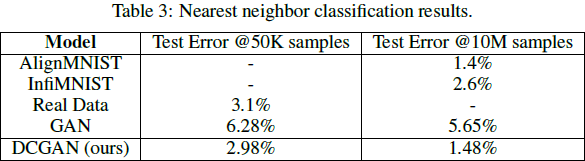
我們建議將標準分類指標應用於模型條件版本,評估學習到的條件分佈。我們在MNIST上(拆分10k驗證資料集)訓練DCGAN以及排列不變的GAN基線,並且使用最近鄰分類器比較實際資料和一組生成的條件樣本來評估模型。我們發現從batchnorm中除移比例和偏差參數對兩個模型都能產生更好的結果。我們推測由batchnorm引入的噪點有助於生成模型更好的從底層數據分佈中探索和生成。結果顯示在Table3,將我們的模型與其他技術進行比較。DCGAN模型實現了與擬合於訓練數據集上的最近鄰分類器相同的測試誤差,這表明DCGAN模型在這個資料集的建模條件分佈方面做得非常出色。每個類別一百萬個樣本,DCGAN模型優於InfiMNIST(Loosli et al., 2007),一個手工開發的資料增強管道,它使用訓練樣本的平移和彈性變形。DCGAN相較於利用類別轉換學習的概率生成資料增強技術(Hauberg et al., 2015)更通用性,因為它直接模擬資料而不是資料的轉換。

Figure 9: Side-by-side illustration of (from left-to-right) the MNIST dataset, generations from a baseline GAN, and generations from our DCGAN .
Figure 9: 並排(由左至右)MNIST資料集,由不同GAN生成照片

Figure 10: More face generations from our Face DCGAN.
Figure 10: 由Face DCGAN生成的更多臉部照片

Figure 11: Generations of a DCGAN that was trained on the Imagenet-1k dataset.
Figure 11: 以DCGAN生成照片,以Imagenet-1k資料集訓練
2018年10月24日 星期三
Building-a-simple-Keras--deep-learning-REST-API文章翻譯
Building a simple Keras + deep learning REST API(文章翻譯)
文章來源:The Keras Blog
原文連結_Keras
這是一篇Adrian Rosebrock的客座文章,Adrian是PyImageSearch.com的作者,這是一個關於機器視覺與深度學習Blog。Adrian最近剛完成一本著作Deep Learning for Computer Vision with python,一本關於深度學習使用Keras進行機器視覺與影像辨識的新書。
在這個教學中,我們將展示一個應用Keras模型並將它佈暑為REST API的簡單方式。
本文範例將做為你建構自己的深度學習API的模板/起點,你將可以擴展程式碼並依著API端點需求的可擴展性及可靠性來自定義。
我們將學習到:
- 如何去(如何不去)將Keras模型載入到記憶體以便可以有效率的用於推理
- 如何使用Flask框架來建立我們的API端點
- 如何利用我們的模型做預測,將結果以JSON-ify回傳到Client端
- 如何利用Python與curl呼叫我們建立的Keras API
最終你將對建立Keras REST API的組件有很好的理解(最簡單的形式)
你可以隨意的使用這個指南的所有程式碼到你的深度學習REST API
注意:這邊介紹的方法用意在於教學,並不代表它可以使用於生產環境或可以負擔高承載。如果你對利用消息隊列或批處理的更高階Keras REST API有興趣,請參考A scalable Keras + deep learning REST API
設置開發環境
我們將假設你已經在你的電腦安裝並設置好Keras。如果沒有,請確保你依著官方文件說明安裝。
之後我們需要安裝Flask(以及它的相依套件),用來建立API端點的Python web開發框架。也需要request,它可以讓我們順利使用我們的API。
相關安裝命令如下:
pip install flask gvent requests pillow
建立Keras REST API
Keras REST API包含在一個單獨文件run_keras_server.py中。為了簡單起見,我們將安裝保存在單一文件中-實作起來可以更簡單的模組化。
在run_keras_server.py中你會發現三個函數,命名如下:
- load_model: 載入Keras模型,並做好準備
- prepare_image: 這函數用來對要透過模型預測的輸入照片做預處理。如果你不是處理影像資料,也許可以考慮將函數名稱變更為更通用的
prepare_datapoint並應用任何你可能執行的資料標準化工作 - predict: API的實際端點,它將對透過請求傳入的資料做分類並回傳結果給Client
此教學的程式碼可以在這邊找到jrosebr1_git
# import the necessary packages
from keras.applications import ResNet50
from keras.preprocessing.image import img_to_array
from keras.applications import imagenet_utils
from PIL import Image
import numpy as np
import flask
import io

# initialize our Flask application and the Keras model
app = flask.Flask(__name__)
model = None
上面程式碼主要載入需求模組以及初始化flask與Keras model
這邊我們定義load_model
- function: load_model
def load_model():
    # load the pre-trained Keras model (here we are using a model
    # pre-trained on ImageNet and provided by Keras, but you can
    # substitute in your own networks just as easily)
    global model
    model = ResNet50(weights="imagenet")
顧名思義,這個函數負責實體化我們的結構以及從磁碟中讀取權重,為了簡單起見,我們將使用Keras已經預訓練好的ResNet50,如果你使用你自定義的模型,那你將可以調整這個函數從磁碟載入模型以及權重。
在我們對來自客戶端的任何資料進行預測之前,我們首先需要準備和資料預處理:
def prepare_image(image, target):
    # if the image mode is not RGB, convert it
    if image.mode != "RGB":
        image = image.convert("RGB")

    # resize the input image and preprocess it
    image = image.resize(target)
    image = img_to_array(image)
    image = np.expand_dims(image, axis=0)
    image = imagenet_utils.preprocess_input(image)

    # return the processed image
    return image
這個函數功能如下:
- 接受輸入照片
- 將照片轉為
RBG(如果需要的話) - 調整照片尺寸為224x224(ResNet的輸入維度,如果你使用自定義模型記得調整為你個人輸入維度)
- 通過均值減法縮放資料
同樣的,在將輸入資料傳遞到模型之前,你應該根據所需的任何預處理,縮放或標準化來修改此函數。
我們現在準備定義predict函數,此函數處理對/predict端點的任何請求。
@app.route("/predict", methods=["POST"])
def predict():
    # initialize the data dictionary that will be returned from the
    # view
    data = {"success": False}

    # ensure an image was properly uploaded to our endpoint
    if flask.request.method == "POST":
        if flask.request.files.get("image"):
            # read the image in PIL format
            image = flask.request.files["image"].read()
            image = Image.open(io.BytesIO(image))

            # preprocess the image and prepare it for classification
            image = prepare_image(image, target=(224, 224))

            # classify the input image and then initialize the list
            # of predictions to return to the client
            preds = model.predict(image)
            results = imagenet_utils.decode_predictions(preds)
            data["predictions"] = []

            # loop over the results and add them to the list of
            # returned predictions
            for (imagenetID, label, prob) in results[0]:
                r = {"label": label, "probability": float(prob)}
                data["predictions"].append(r)

            # indicate that the request was a success
            data["success"] = True

    # return the data dictionary as a JSON response
    return flask.jsonify(data)
dict參數data主要用來保存任何要回傳給Client端的資料,success的boolean用來做為預測成功與否的指標,我們也用這個dict參數保存輸入資料的預測結果。
接收傳入資料時我們需要檢核:
request method是POST(允許我們發送任意資料到這個端點,包含照片、JSON、編碼資料…等)- 在POST期間,照片已經寫入
files
接著我們取得傳入的資料:
- 利用PIL讀取它
- 執行資料預處理
- 利用網路傳輸
- 迴圈保存結果並將資料list格式寫入
data["predictions"] - 以JSON格式回傳結果至Client端
如果你正使用非影像資料,那你應該移除request.files並自行解析輸入資料或利用request.get_json()自動解析資料將格式轉為Python dict或是物件。此外,可以考慮參考bar-talk:processing incoming request data in flast,這是一個討論flask請求對象的基礎。
剩下要做的就是啟動我們的服務:
# if this is the main thread of execution first load the model and
# then start the server
if __name__ == "__main__":
    print(("* Loading Keras model and Flask starting server..."
        "please wait until server has fully started"))
    load_model()
    app.run()
首先我們呼叫load_model從磁碟載入Keras model
呼叫load_model是一個阻斷式作業(blocking operation),並阻止web service啟動,一直到模型完成載入。如果我們沒有確保模型完全載入記憶體,並且在啟動web service之前,那我們可能會遇到下面狀況:
- 一個
request被POST到伺服器 - 伺服器接收
request,預處理資料並嚐試將資料傳入模型 - 但模型尚未被確實的載入,我們的腳本將會異常。
當建置自定義Keras REST API時,請確保插入邏輯以保證在接受請求之前模型是載入完成並準備推理。
如何不要在REST API中載入Keras模型
你也許會嚐試將模型載入寫在predict,就像這樣:
    # ensure an image was properly uploaded to our endpoint
    if request.method == "POST":
        if request.files.get("image"):
            # read the image in PIL format
            image = request.files["image"].read()
            image = Image.open(io.BytesIO(image))

            # preprocess the image and prepare it for classification
            image = prepare_image(image, target=(224, 224))

            # load the model
            model = ResNet50(weights="imagenet")

            # classify the input image and then initialize the list
            # of predictions to return to the client
            preds = model.predict(image)
            results = imagenet_utils.decode_predictions(preds)
            data["predictions"] = []
這段程式碼意味著每來一個新的request就會重新載入一次模型,這非常低效而且可能導致你的系統記憶體不足。
如果你執行上面程式碼,你會發現你的API執行非常的慢(特別是如果你的模型很大的話),這是因為每一個request都重新載入模型造成CPU與IO顯著的開銷。
看看它如何簡單的擊潰你的伺服器記憶體,假設我們同時有N個request傳入,這代表同時會有N個模型被載入記憶體,如果你的模型非常大,像ResNet,保存了N份在記憶體,這非常容易耗盡你的記憶體。
為此,盡量避免每一個request都載入一次模型,除非你有非常具體合理的理由來做這件事。
警告:我們假設你使用的是單線程的Flask服務(預設值)。如果你佈署多線程的服務,即使使用本文討論較正常的方式,還是有可能會一次載入多個模型進記憶體。如果你考慮使用專用的伺服器,像是Apache或nginx,你應該考慮讓你的管理更具擴展性,參考scalable keras deep learning rest api
啟動Keras REST API
啟動Keras REST API服務非常簡單,開啟終端機並執行:
$ python run_keras_server.py
Using TensorFlow backend.
 * Loading Keras model and Flask starting server...please wait until server has fully started
...
 * Running on http://127.0.0.1:5000
從輸出可以看的出來,模型優先載入,接著我們可以啟動Flask服務,你可以通過http://127.0.0.1:5000來連結伺服器。然而,如果你直接將上述連結直接貼到瀏灠器,你會看到下面的圖片:
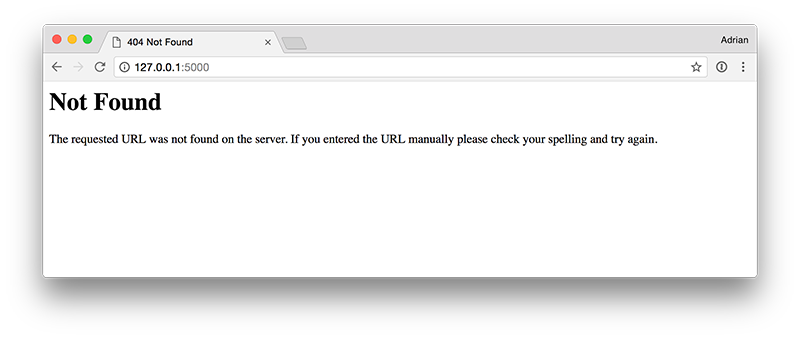
原因是因為Flask URL路由中沒有設置主頁(app.route('/')),相反的你試著直接訪問http://127.0.0.1:5000/predict,會看到如下圖片:
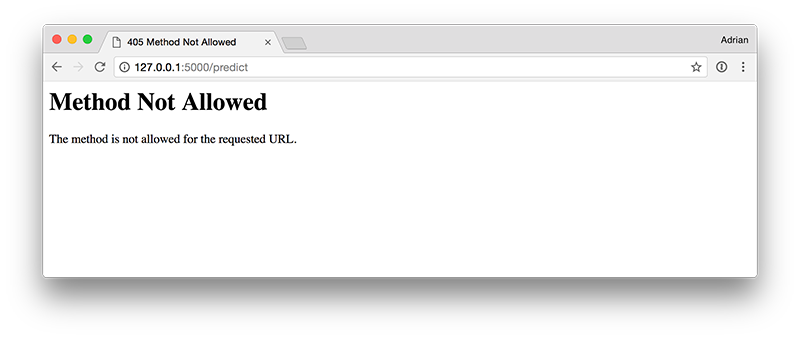
你將看到Method Not Allowed異常訊息,這是因為你的瀏灠器正在執行GETrequest,但你的路由僅接受POST(下一節將展示如何執行)
使用cURL來測試Keras REST API
在測試或調試Keras REST API的時候,可以考慮使用cURL(無論如何,這是一個學習如何使用的好工具)
下面的照片是我們要做分類用的,一條狗,更正確的說是一條小獵犬
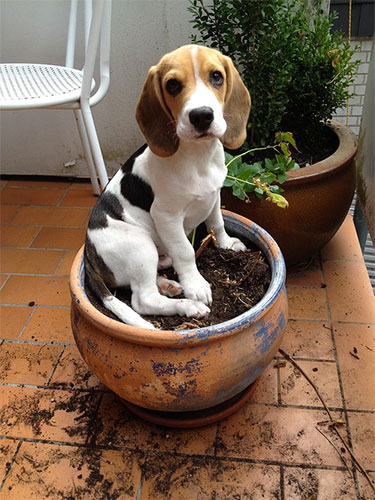
我們可以使用curl將照片傳到API並找出ResNet認定的照片內容:
$ curl -X POST -F image=@dog.jpg 'http://localhost:5000/predict'
{
  "predictions": [
    {
      "label": "beagle",
      "probability": 0.9901360869407654
    },
    {
      "label": "Walker_hound",
      "probability": 0.002396771451458335
    },
    {
      "label": "pot",
      "probability": 0.0013951235450804234
    },
    {
      "label": "Brittany_spaniel",
      "probability": 0.001283277408219874
    },
    {
      "label": "bluetick",
      "probability": 0.0010894243605434895
    }
  ],
  "success": true
}
-X POST代表我們正執行一個POST request
-F image =@dog.jpg代表我們正提交表單編碼資料,image的鍵值設置為@dog.jpg的內容,@符號意味著我們希望cURL載入該影像內容並將資料傳給該request
http://localhost:5000/predict代表執行的端點
注意到該輸入照片被正確歸類到beagle,並且有99.01%的置信度,其餘的top-5預測對象與概率也包含在我們Keras REST API響應中。
在程式碼內使用Keras REST API
十之八九,你將同時向Keras REST API提交資料,並以某種方式使用回傳的預測,這需要以寫程式的方式來處理伺服器的響應。
這是一個使用Python模組request的直接過程:
- file name: simple_request.py
# import the necessary packages
import requests

# initialize the Keras REST API endpoint URL along with the input
# image path
KERAS_REST_API_URL = "http://localhost:5000/predict"
IMAGE_PATH = "dog.jpg"

# load the input image and construct the payload for the request
image = open(IMAGE_PATH, "rb").read()
payload = {"image": image}

# submit the request
r = requests.post(KERAS_REST_API_URL, files=payload).json()

# ensure the request was successful
if r["success"]:
    # loop over the predictions and display them
    for (i, result) in enumerate(r["predictions"]):
        print("{}. {}: {:.4f}".format(i + 1, result["label"],
            result["probability"]))

# otherwise, the request failed
else:
    print("Request failed")
KERAS_REST_API_URL指向我們的端點
IMAGE_PATH指向照片路徑
使用IMAGE_PATH來載入照片,並且結構化payload給予request。
給定payload,我們可以使用request.postPOST資料到我們的端點,將.json()加入語法的最後會指示以下request:
- 伺服器的響應(response)必需是JSON
- 我們希望為我們自動解析和反序列化JSON object
一但我們得到該request的輸出,r,我們可以確認分類是否成功,並迴圈r['predictions']取得資料。
執行simple_request.py,首先要確認run_keras_server.py(即flask服務)是否啟動,在shell中執行下面指令:
$ python simple_request.py
1. beagle: 0.9901
2. Walker_hound: 0.0024
3. pot: 0.0014
4. Brittany_spaniel: 0.0013
5. bluetick: 0.0011
我們成功的利用Python呼叫了Keras REST API,並獲得模型預測結果。
這篇文章中你學到了:
- 使用Flask Web Framework將Keras model包裝為REST API
- 使用
cURL來派送資料到API - 使用Python以及模組
request來派送資料到端點並使用結果
該教程的程式碼可以在jrosebr1_git找到,這代表它可以用來當你的Keras REST API的基板,你可以任意修改它。
請記住,這文章中的程式碼是引導用的,並不代表它可以使用於生產環境或可以負擔高承載。
以下情況最好使用此方法:
- 你需要快速為你的Keras模型建立REST API
- 你的端點不會被重擊(負載過大的意思?)
如果你對利用消息隊列和批處理的進階Keras REST API感興趣,請參閱此blog。
如果你對該文章有任何的問題或評論,請移駕至Adrian from PyImageSearch。未來主題的建議請至Twitter上尋找Francois on Twitter
YOLOv3實作整理
tags:
YOLOv3YOLODeepLearning相關模型可參考在下的github
YOLOv3,現在都已經v8了,我可能才剛整理好v3,因為我個人習慣上是盡可能的希望可以自己硬寫一發,神經網路可能是黑盒子無法解釋,但是方法本身如果是可解釋的我就盡可能的去瞭解,不過還是有一些小細節沒有很完整,但至少我有信心看完我寫的資料之後你也可以絕大部份的掌握YOLOv3,這對你再往後延伸閱讀很有幫助。
物體偵測的資料格式與一般分類任務的標記有很大的不同,也因此我們在實作之前一定要先能夠處理資料的轉變。舉例來說,如果是分類任務的話,那一張照片也許就是一個類別,但如果是物體偵測的話,那也許一張照片上面就有四五個物體標記資訊了。
也因此,我們就先需要做些資料處理的前置動作,這部份你可以參考Arch_YOLO_dataset_preprocess_1.ipynb以及Arch_YOLO_dataset_preprocess_2_data_for_yolov3.ipynb
這兩份文件主要在說明資料的前置處理,以及產生模型中計算loss所需要的資料格式。
整理好訓練資料之後就可以開始著手處理模型,我們知道,YOLOv3採用Darknet-53做為骨幹,這意謂著它有53層,骨幹的意思就是最主要的模型架構,但這是骨幹,YOLOv3的輸出跟Darknet-53是不一樣的,一個是做為物體偵測,一個是做為分類任務。
下圖給出YOLOv3的完整架構:
可以看的出來主要是將不同大小的feature map做結合,讓大小資訊可以結合在一起做為輸出預測,這樣子不同尺寸的ancbor box就可以有比較豐富的資訊。
針對Darknet與YOLOv3的模型說明可以參考Arch_YOLOv3_1_Darknet-53_structure.ipynb與Arch_YOLOv3_2_YOLOv3_structure.ipynb的說明。這兩篇文章中對於架構的部份有著較為詳細的說明,可以更直觀的瞭解到模型中特徵圖(feature map)的變化。
接下來要處理的就是loss function,自己手寫過一次就會有一種,『啊,原來還可以這樣處理』的感覺出現。如下圖所示:
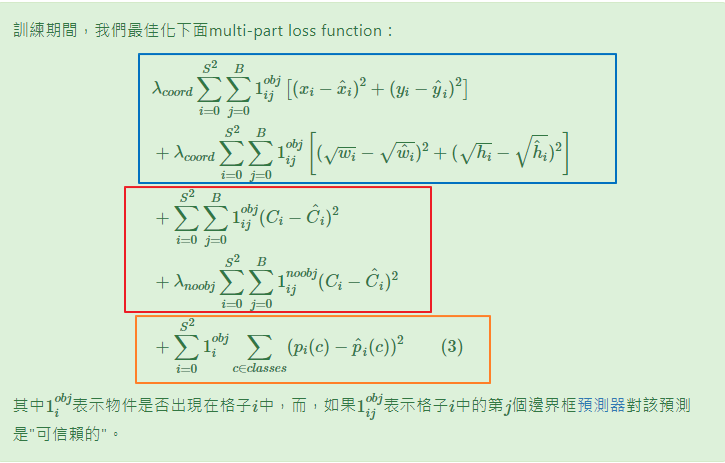
loss function的部份大致分為三個部份:
詳細的細節可以參考Arch_YOLOv3_3_loss_function。框的好不好可以用IoU來判斷,有沒有信心跟框到什麼就是用cross_entropy,這很標準。不過或許是因為我沒有先用影像分類的任務來做預訓練,訓練起來有點不順利,也因此loss function的部份我在實作上是有做些許調整的。
在Arch_YOLOv3_3_loss_function裡面有一個函數,decoder,這主要是拿來調整模型得到的feature map,整個資料流大致如下:
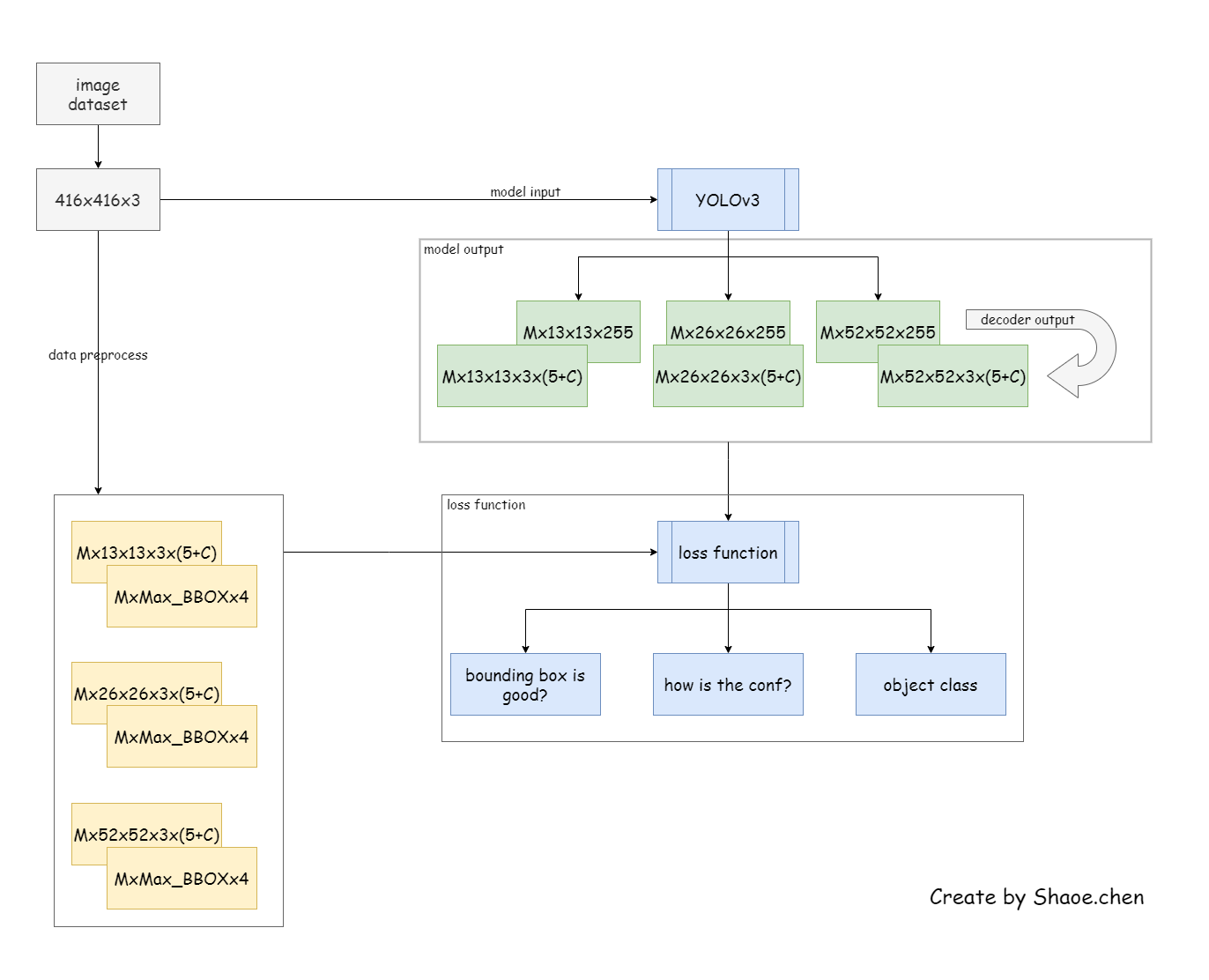
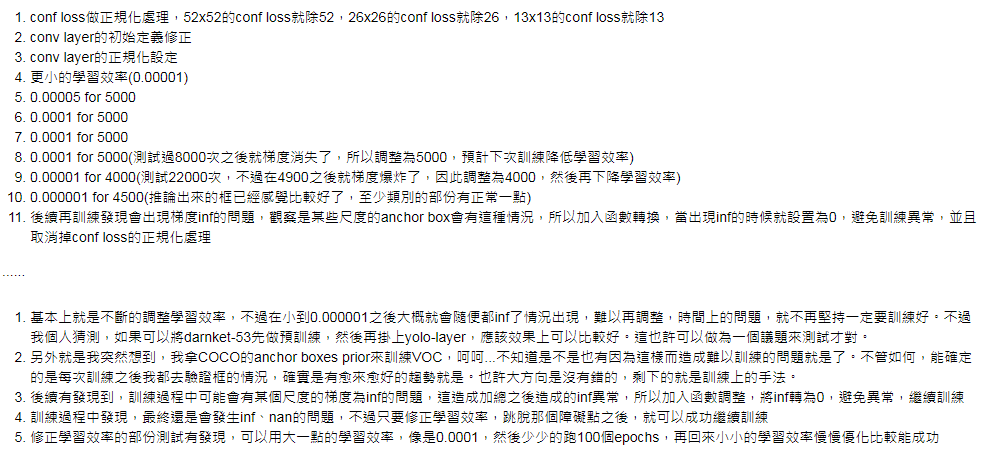
現在我們已經可以進入訓練的步驟了,有一些說不上來的細節,像是AP50之類的計算我還沒有實作上,所以目前來看是沒有這一個數值可以提供參考的,唯一有的就是loss。正如上面提到的,或許是因為我沒有先做預訓練,所以訓練過程中常常會造成梯度的消失或是爆炸等問題。也因此整個訓練過程真的很長,常常早上看的時候發現loss又nan,我把我的訓練過程通通寫在Arch_YOLOv3_4_training,算是幫自己做個過程中記錄:
訓練之後我們需要做個推論測試,所以拿了張照片就看看它的原始狀態,再用我們訓練完成的模型看看推論出來的狀態,這可以參考Arch_YOLOv3_5_predict。得到的推論結果如下:
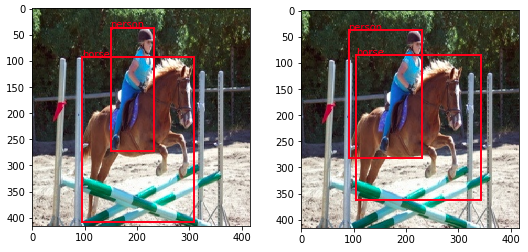
上圖左是原始框的資料,然後上圖右是訓練後模型推論得到的資料,結果看似不錯,不過中間還是存在置信度的問題就是了,或許還需要更次的迭代。
以上就差不多是整個模型的處理過程了,前陣子已經看到發表YOLOv8了,我的v4才正要開始動手,有點慢,不過相信有這個基礎在可以很快速的推進才是。